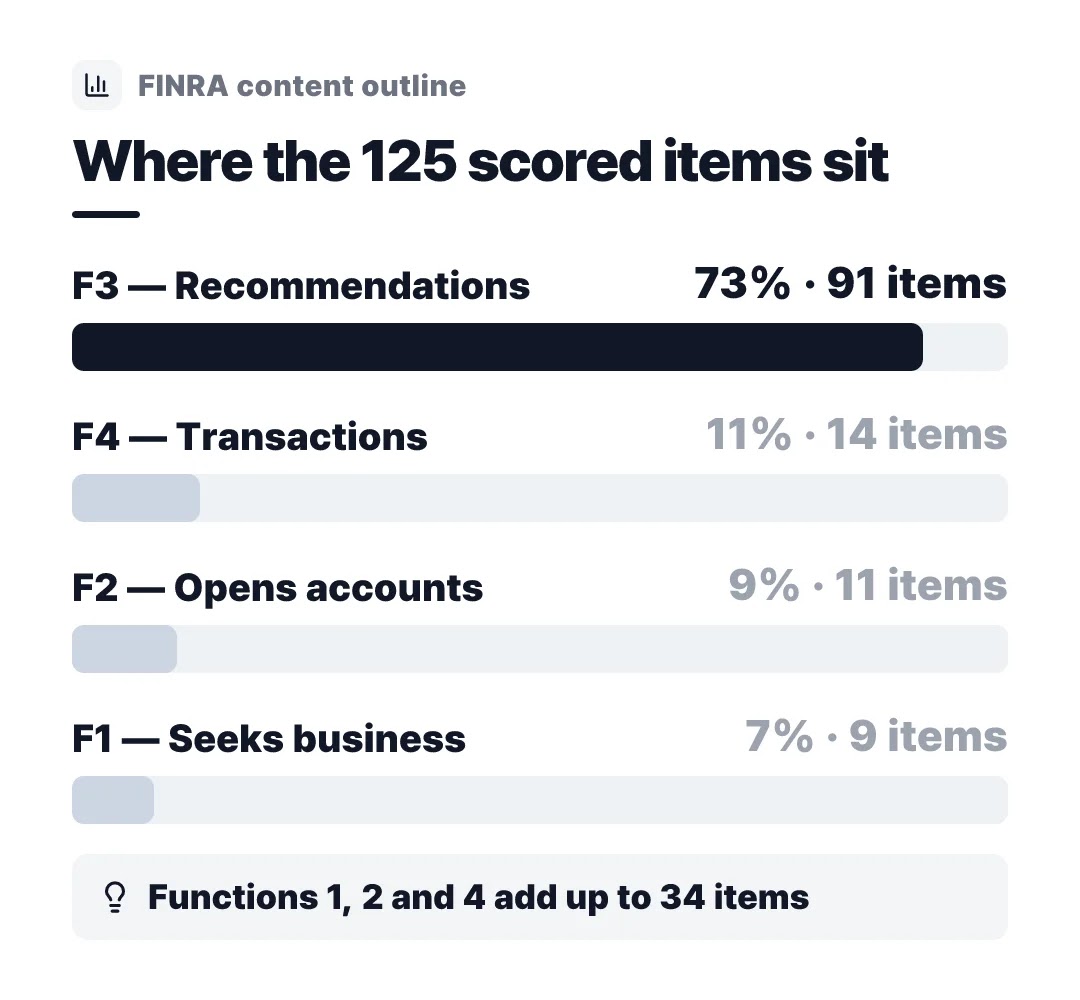
Ninety-one of the 125 scored items on the Series 7 belong to a single job function. FINRA's content outline assigns 73 percent of the exam to Function 3 — providing customers with information, making recommendations, transferring assets and maintaining records — which is more scored items than the entire SIE contains. Everything about how you prepare follows from that one number.
What the Series 7 adds to the SIE
FINRA calls the SIE a co-requisite, not a prerequisite, and the wording matters. The content outline states that to obtain registration as a General Securities Representative, candidates must pass both the Series 7 exam and a general knowledge co-requisite, the Securities Industry Essentials exam. Either order works. What you cannot do is register on one alone.
The two exams are also aimed at different things. The SIE tests industry-wide general knowledge — product definitions, market structure, regulators. The Series 7 tests what a registered representative does with that knowledge in front of a customer. Pass both and the registration permits solicitation, purchase and sale of corporate securities, municipal fund securities, options, direct participation programs, investment company products and variable contracts. The activities it covers are set out in FINRA Rule 1220(b)(2).
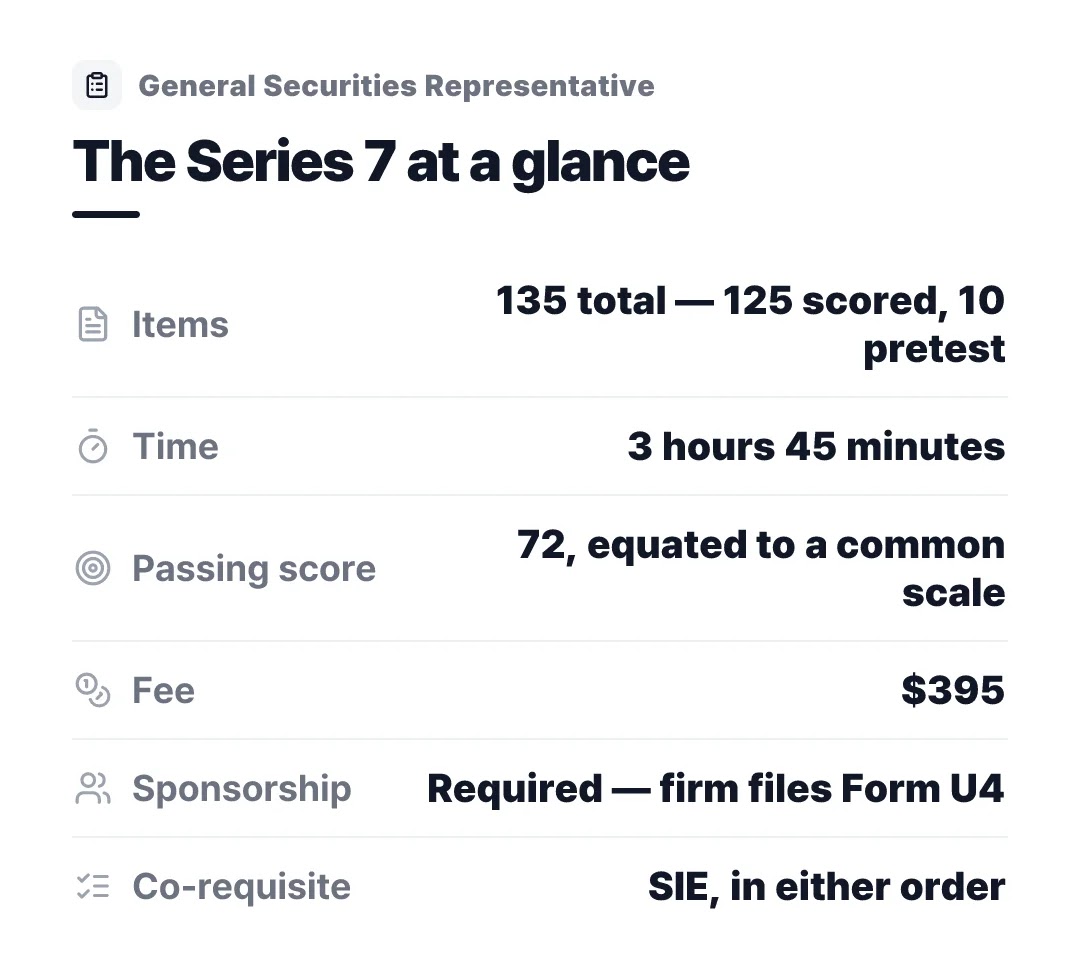
The form itself runs 135 items: 125 scored plus 10 unidentified pretest items that do not count, distributed at random, with 3 hours and 45 minutes to work through all of them. There is no penalty for guessing. Scores are equated onto a common scale, so the passing mark of 72 is a scaled figure rather than a raw tally of right answers.
Sponsorship is the gate, and the clock starts at Form U4
Here the two exams part company. Anyone 18 or older can schedule the SIE with no firm involved. The Series 7 requires association with a FINRA member firm, and the firm opens the door by filing Form U4 on your behalf. You cannot enroll yourself, which is why the practical question for most candidates is not how to study but how to get hired first.
Once the firm files, FINRA opens a 120-day window in which you must schedule and sit the exam. Miss it and the enrollment has to be redone, with the fee paid again. Testing centers in dense metro areas book out weeks ahead, so the window is shorter in practice than it looks on paper — treat the U4 filing date, not your start date, as the beginning of the countdown.
Most representatives also need a state law exam. That is the Series 63, a NASAA exam administered by FINRA, and it is a separate registration with a separate fee.
| Exam | Owned by | Firm sponsorship | Scored items | Time | Passing | Fee |
|---|---|---|---|---|---|---|
| SIE | FINRA | Not required | 75 | 1 h 45 min | 70 | $100 |
| Series 7 | FINRA | Required (Form U4) | 125 | 3 h 45 min | 72 | $395 |
| Series 63 | NASAA, administered by FINRA | Registration-driven | 60 | 75 min | 43 of 60 | $147 |
Figures come from each exam's official FINRA page; the Series 63 also carries five unscored items, and the SIE and Series 7 carry ten each. Added up, the three exam fees come to $642 before a single day of prep material or a single dollar of commission.

Ninety-one of the 125 items sit in one function
The four job functions are not remotely balanced, and the imbalance is the whole study plan.
| Function | Weight | Scored items |
|---|---|---|
| 1 — Seeks business for the broker-dealer | 7% | 9 |
| 2 — Opens accounts after evaluating the customer's financial profile | 9% | 11 |
| 3 — Provides information, makes recommendations, transfers assets, maintains records | 73% | 91 |
| 4 — Obtains and verifies purchase and sales instructions; processes transactions | 11% | 14 |
Weights and item counts are from FINRA's Series 7 content outline.
Functions 1, 2 and 4 together account for 34 items. You could sit down knowing them cold and still be looking at a failing score, because Function 3 alone decides the outcome. That is also where the material people find hardest lives: options mechanics, municipal securities, margin, packaged products, and the suitability judgment that ties a product to a customer profile.
The practical consequence is that broad, even coverage is the wrong instinct here. Reading Function 1 twice buys you nine items. An extra pass over options break-even arithmetic buys you a share of ninety-one. When study time is short, the ratio is not close.
How the 40 pages are arranged
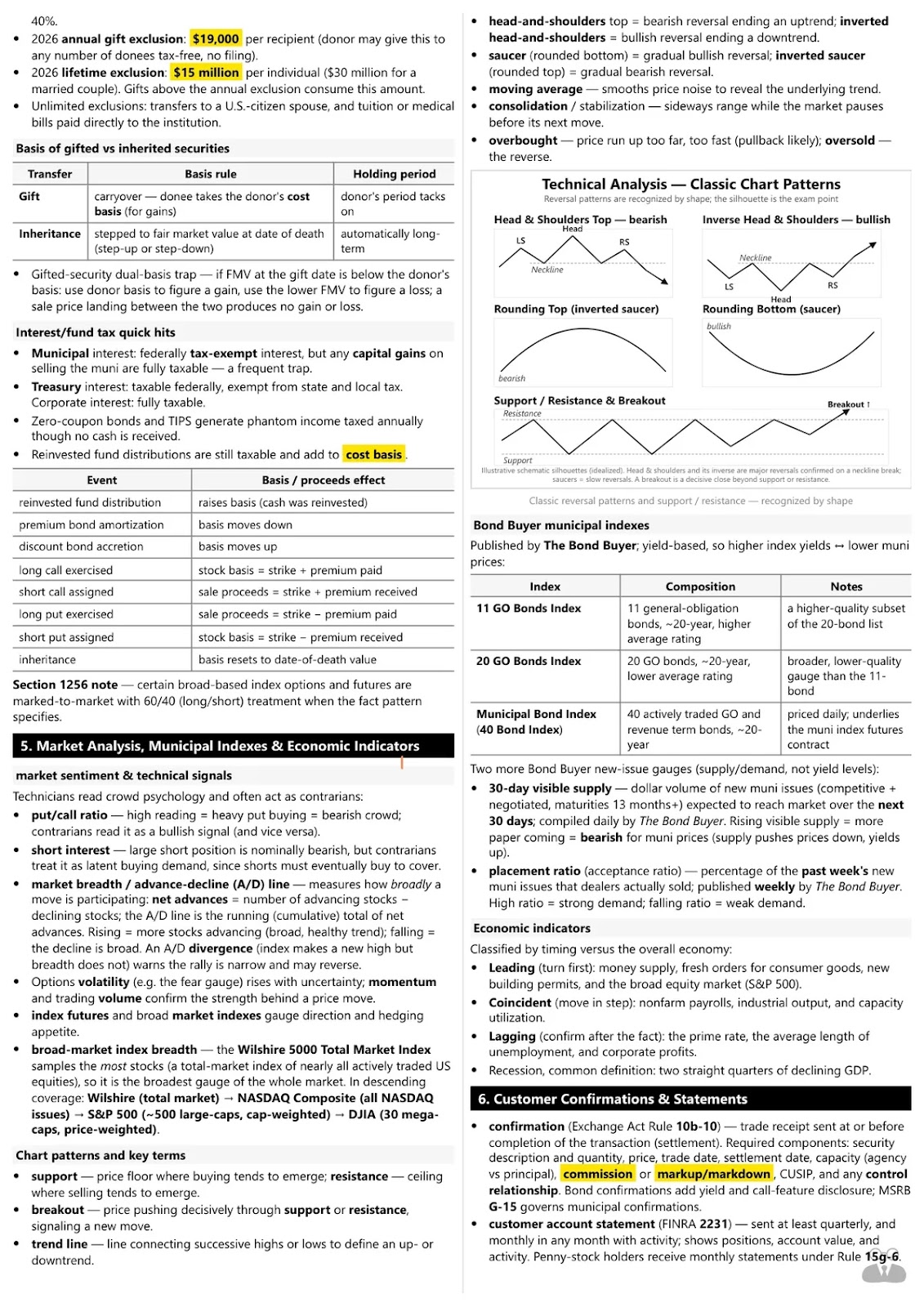
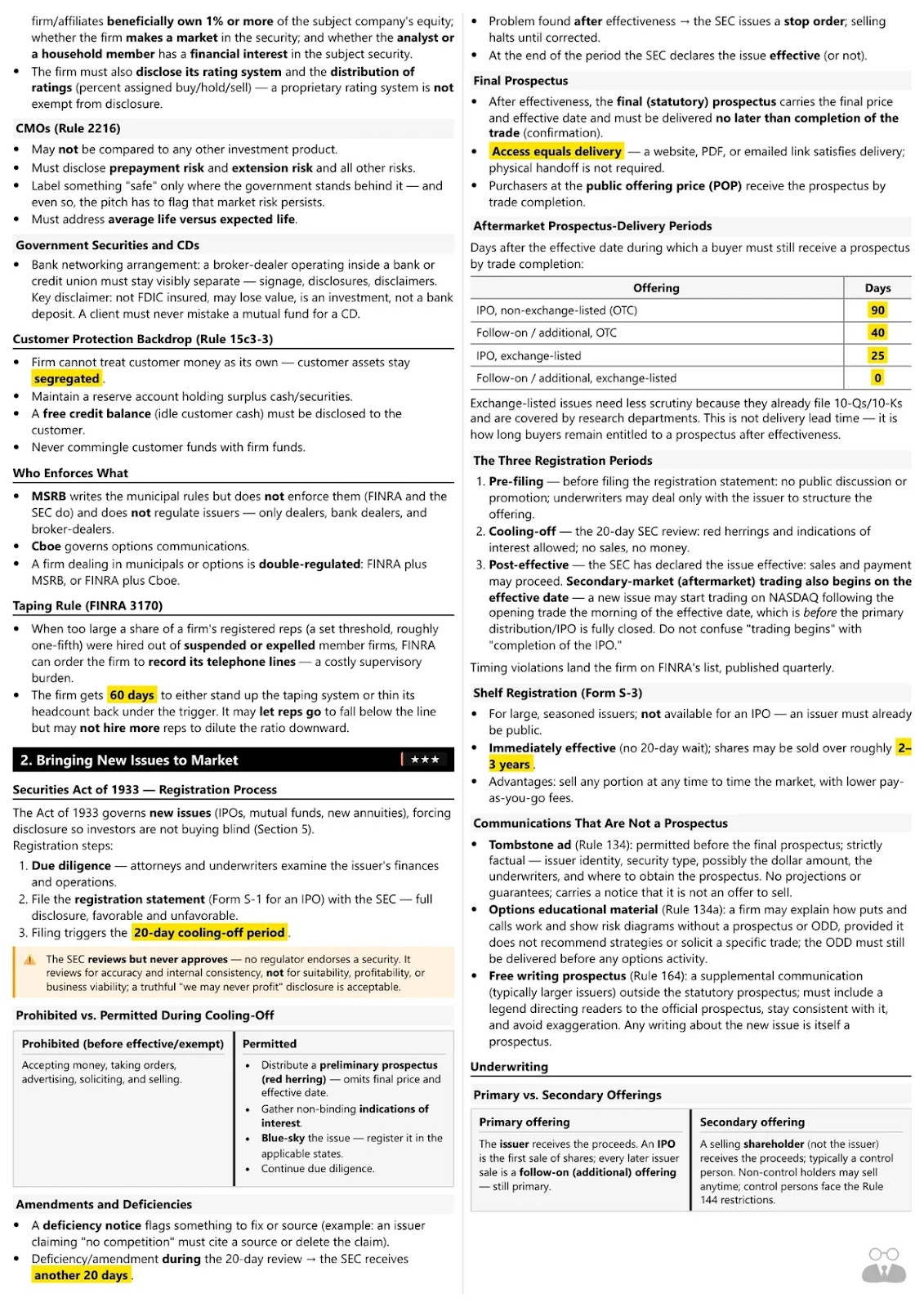
Crammist's Series 7 notes run 40 pages and follow the outline's weighting rather than a textbook's chapter order — the review is centered on the highest-weight domains, so lighter corners of the outline are represented lightly. Options, municipal securities and margin take the space, because Function 3 takes the exam.
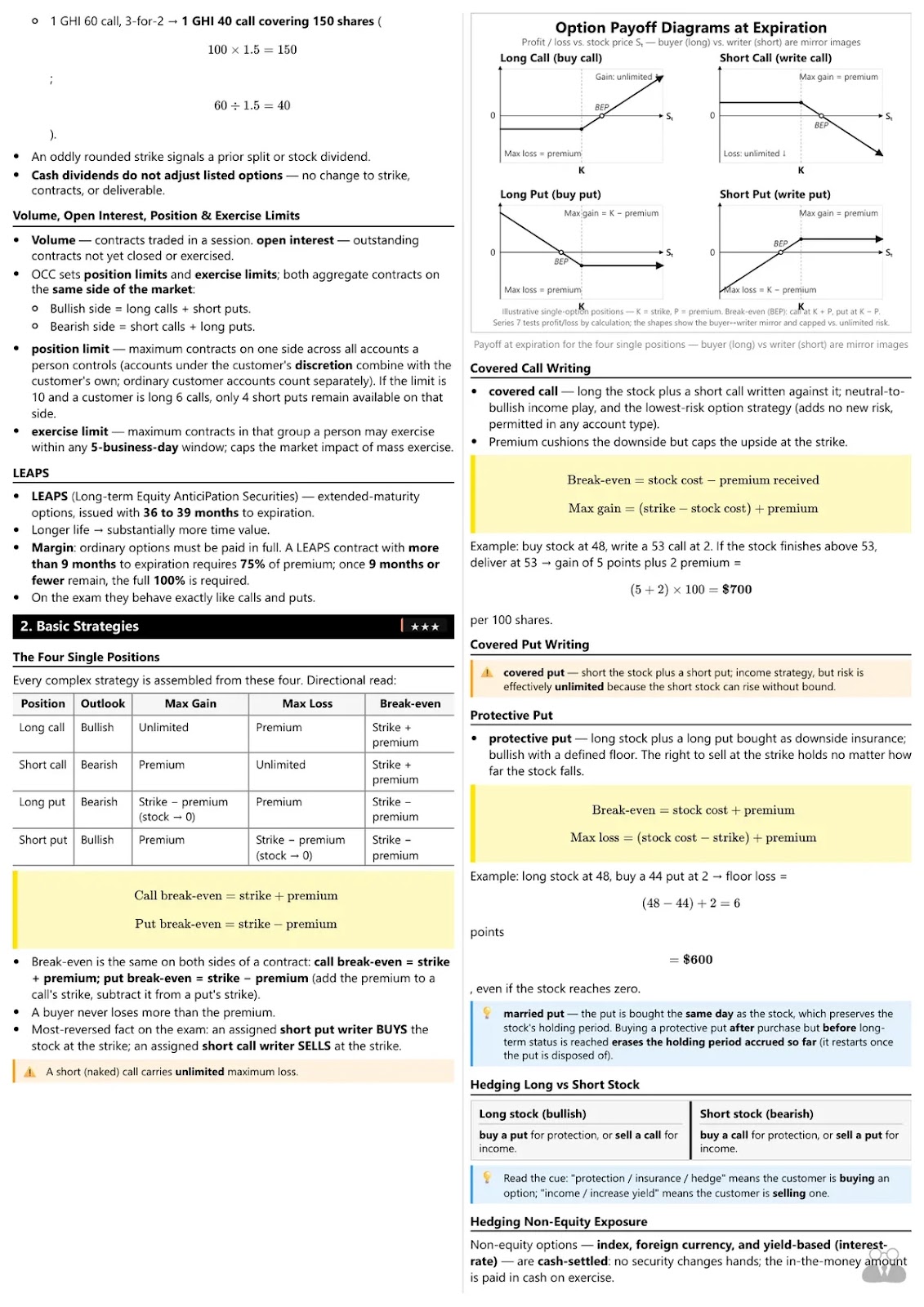
The options material is built the way the questions are: the four single positions in one table with outlook, max gain, max loss and break-even side by side, then payoff diagrams showing the buyer-writer mirror, then the strategies assembled from them. Covered call writing carries break-even as stock cost minus premium received with a worked example — buy at 48, write a 53 call at 2, deliver at 53 for a gain of 5 points plus 2 premium, $700 per 100 shares. Protective puts get the same treatment, including the married-put wrinkle about the holding period.
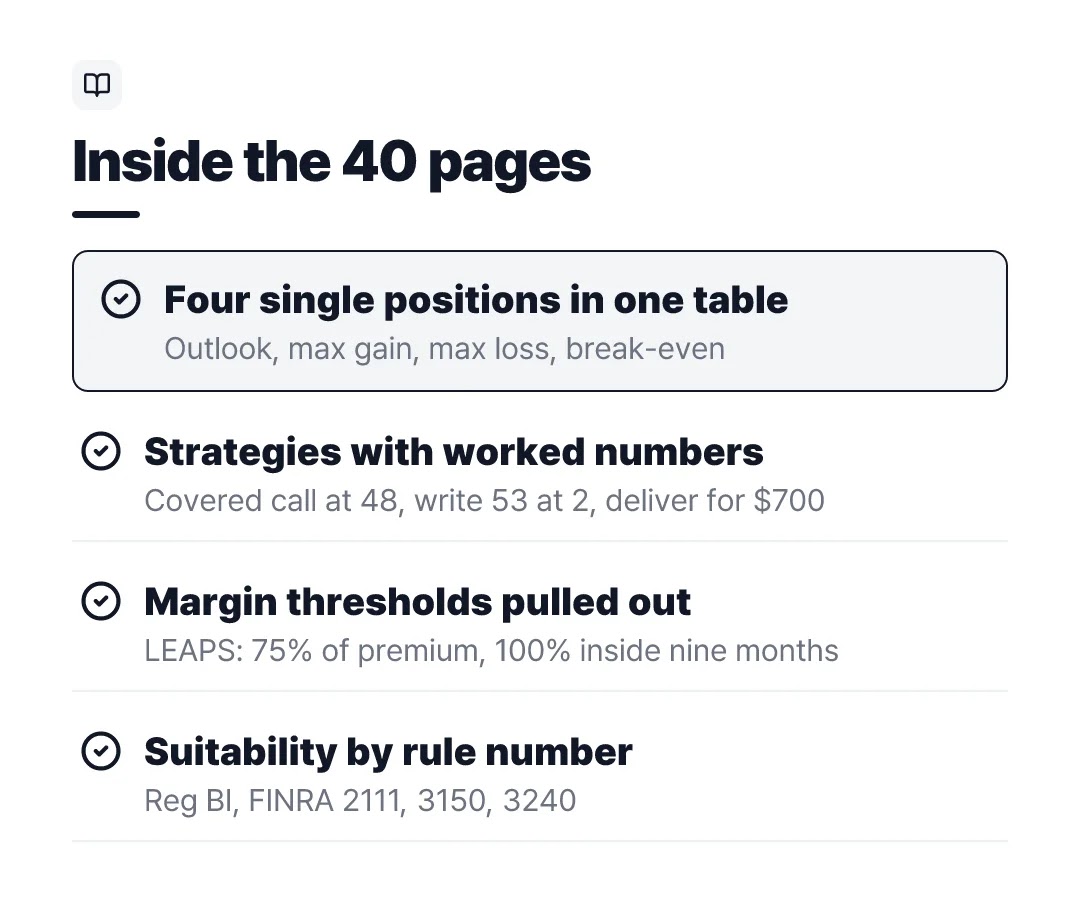
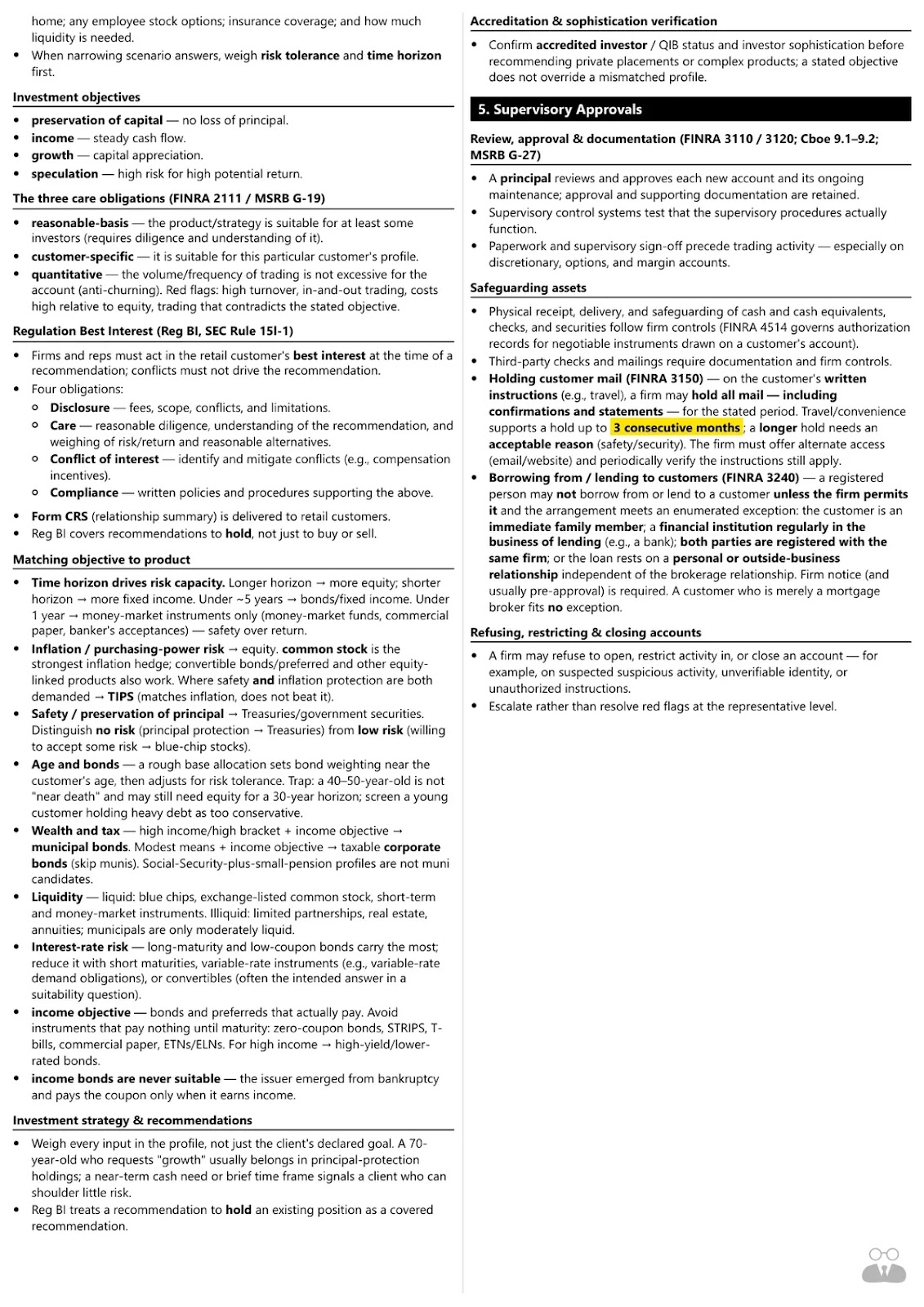
Detail that gets tested as a number is pulled out rather than buried. LEAPS require 75 percent of the premium as margin with more than nine months to expiration and the full 100 percent once nine months or fewer remain. Exercise limits run on a five-business-day window. Position limits aggregate the bullish side, long calls plus short puts, against the bearish side. On the suitability half, Regulation Best Interest is broken into its four obligations, the three care obligations under FINRA 2111 are separated, and rules that generate scenario questions — holding customer mail for up to three consecutive months under FINRA 3150, the borrowing and lending exceptions under FINRA 3240 — are stated with their rule numbers.
👉 Series 7 study notes — PDF (40 pages)
https://www.crammist.com/library/series-7-exam-cram
What candidates ask first
Can I take the Series 7 before the SIE?
Yes. FINRA treats the SIE as a co-requisite rather than a prerequisite, so the order does not affect your registration. Both must be passed, and the Series 7 half still requires that you be associated with a member firm when you sit it.
Do I need a job offer to take the Series 7?
In practice, yes. The exam requires firm sponsorship, and the firm initiates it by filing Form U4. Candidates who want to demonstrate commitment before they are hired usually sit the SIE first, since it has no sponsorship requirement and stays valid for four years.
Is the Series 63 part of the Series 7?
No. It is a separate NASAA exam administered by FINRA, with its own 60 scored questions, 75-minute sitting and $147 fee. Whether you need it depends on the states where you will be registered, so confirm the requirement with your firm's registration desk rather than assuming.
Where this leaves you
The Series 7 is 135 items in 3 hours and 45 minutes, 125 of them scored, with a scaled passing mark of 72. Function 3 holds 91 of those scored items, which makes options, municipals, margin and suitability the exam rather than a part of it. Sponsorship, not study time, is the gating step, and the 120-day window opens when your firm files the U4.
Once your window opens, book the seat first and plan the study weeks backward from that date — then give Function 3 the share of those weeks its 91 items actually warrant.
📄 What Function 3 actually asks — 40 pages
https://www.crammist.com/library/series-7-exam-cram
Crammist is an independent publisher of study materials and is not affiliated with FINRA, NASAA, or any securities regulator or self-regulatory organization. These notes are not official exam material and are not investment, legal, or tax advice.