
Is the life and health insurance license exam the same test in every state? It isn't. Each state's department of insurance sets its own exam and hires a testing vendor to run it, so the number of questions, the time limit, the passing score, and even whether life and health are tested together or separately depend on where you apply. This guide compares Texas, Florida, California, and New York under the outlines in force in 2026, then shows how to confirm the current version for your own state.
Why there is no national life and health insurance exam
Insurance is regulated state by state in the U.S. The NAIC (National Association of Insurance Commissioners) writes model laws that many states adopt, but it does not license anyone. Your state department of insurance decides who is eligible, what pre-licensing education is required, and which vendor delivers the exam. Texas and Florida contract with Pearson VUE; California and New York use PSI.
The vendor publishes the document you actually study from: a candidate handbook (Pearson VUE) or candidate information bulletin (PSI), each with a content outline and an effective date. Every outline has two parts. The general knowledge portion covers products and concepts such as whole life, riders, Medigap, and disability income, and it looks broadly similar from state to state. The state law portion covers that state's insurance code, and it is where a study guide written for another state stops being useful.
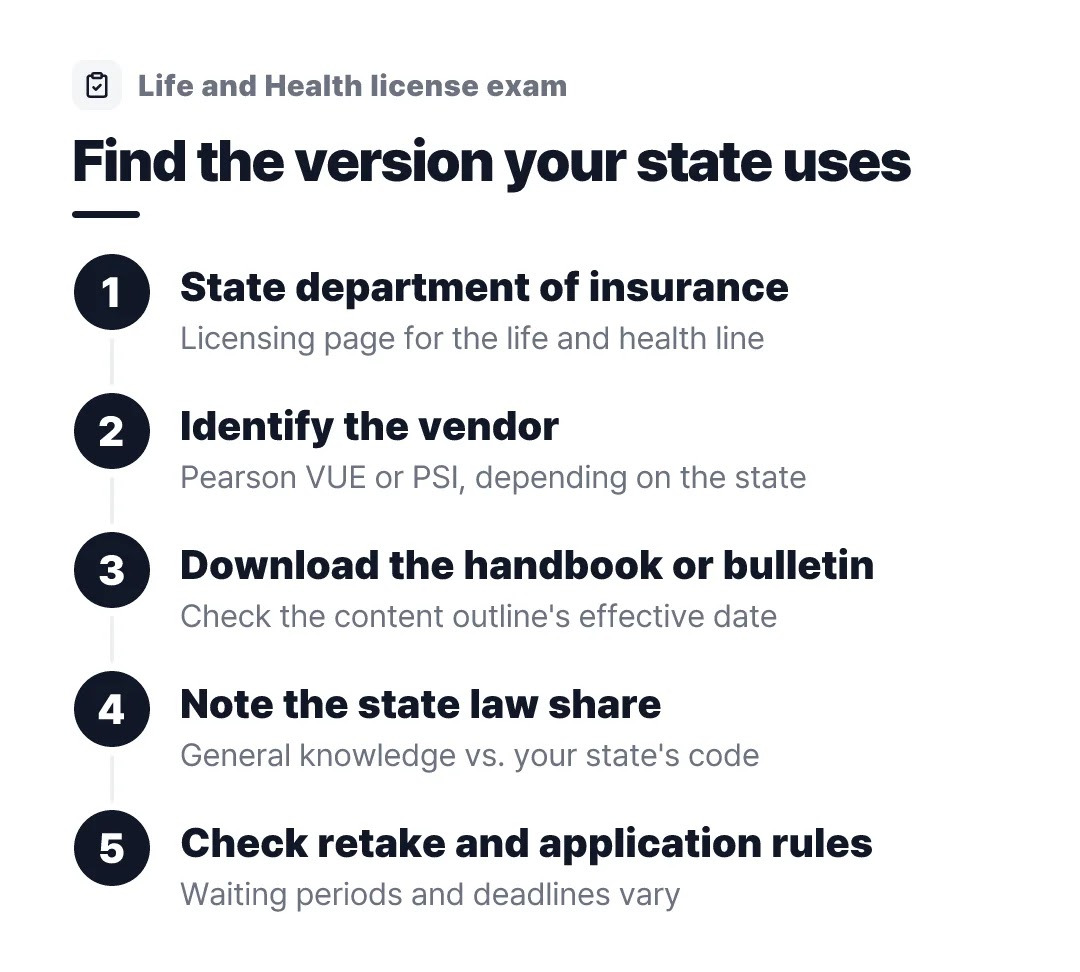
That effective date matters more than most candidates expect. Pearson VUE's Texas content outlines were reissued effective September 1, 2026, and Florida's outlines took effect January 1, 2026. A prep book printed before those dates may still be close, but the outline itself is the only document that tells you what is scored this year.
Four states, four different exams in 2026
Texas calls its license General Lines – Life, Accident and Health. Under the September 1, 2026 outline, the exam has 100 scored general knowledge questions and 30 scored Texas law questions, plus 15 unscored pretest items mixed in. You get 150 minutes, the test-center fee is $49, and the passing score of 70 applies to the exam as a whole rather than to each part. A failed candidate can rebook the next day with no cap on attempts, and you must apply for the license within 12 months of passing.
Florida's combined exam is the 2-15, Life including Variable Annuities and Health. It runs 150 scored questions plus 15 pretest questions in 2.75 hours, and a third of the exam is Florida law: 13% on statutes common to all lines, 10% on life and annuity rules, and 10% on health rules. Florida also offers separate Life and Health exams at 85 scored questions and 2 hours each.
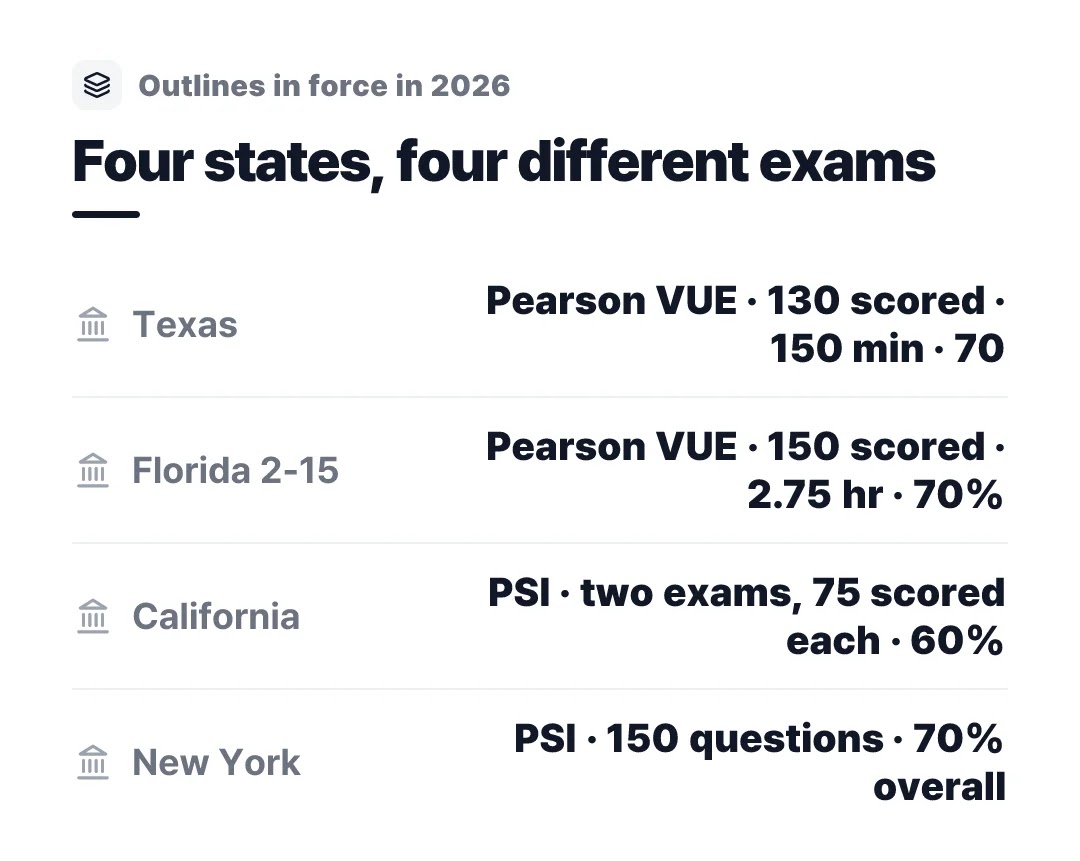
California splits the two lines. The Life-Only exam and the Accident and Health or Sickness exam are separate PSI exams, each with 75 scored questions in 1 hour 45 minutes, and 60% passes. California no longer requires the older 20-hour line-specific pre-licensing courses; the remaining requirement is a 12-hour course on ethics and the California Insurance Code. New York's combined Life, Accident and Health exam through PSI has 150 questions and requires 70% overall. Published figures for New York's time limit conflict between prep providers, so take that number from the current PSI bulletin rather than from a blog, this one included.
Where the outline puts the weight, and where our notes cover it
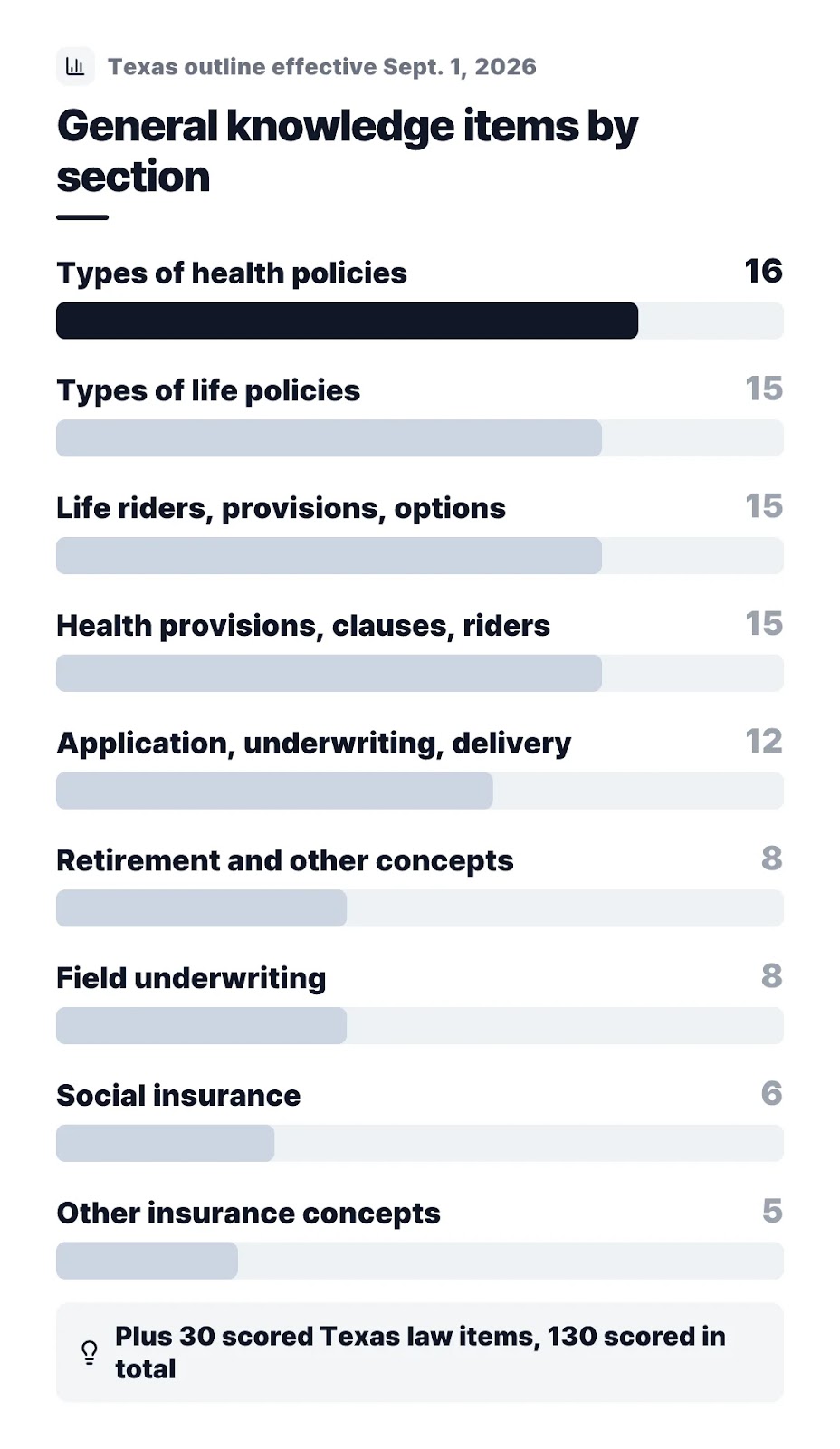
Because Texas and Florida both use Pearson VUE's general knowledge structure, their outlines can be lined up section by section. The table below takes the four sections that the Crammist notes cover in the preview pages and shows how much each one counts in the two states.
| Outline section | Texas (of 100 general items) | Florida 2-15 (share of exam) | Where it sits in the notes |
|---|---|---|---|
| Life policy riders, provisions, options, and exclusions | 15 | 10% | Ch. 5: beneficiaries, settlement options, nonforfeiture, loans, dividends, disability riders |
| Types of health policies | 16 | 11% | Ch. 10 disability income and Ch. 14 Medigap and long-term care |
| Health policy provisions, clauses, and riders | 15 | 10% | Ch. 9: uniform required and optional provisions |
| Social insurance | 6 | 4% | Ch. 14: Medicare coordination and Medicaid |
Texas item counts come from the Pearson VUE Texas content outline effective September 1, 2026, Florida shares from the Pearson VUE Florida outline effective January 1, 2026, and chapter references are from the PDF's preview pages. Together those four sections account for 52 of Texas's 100 general knowledge items and 35% of Florida's 2-15. That is the case for starting with provisions and health products rather than working through the outline from the top.
A study order built around the outline
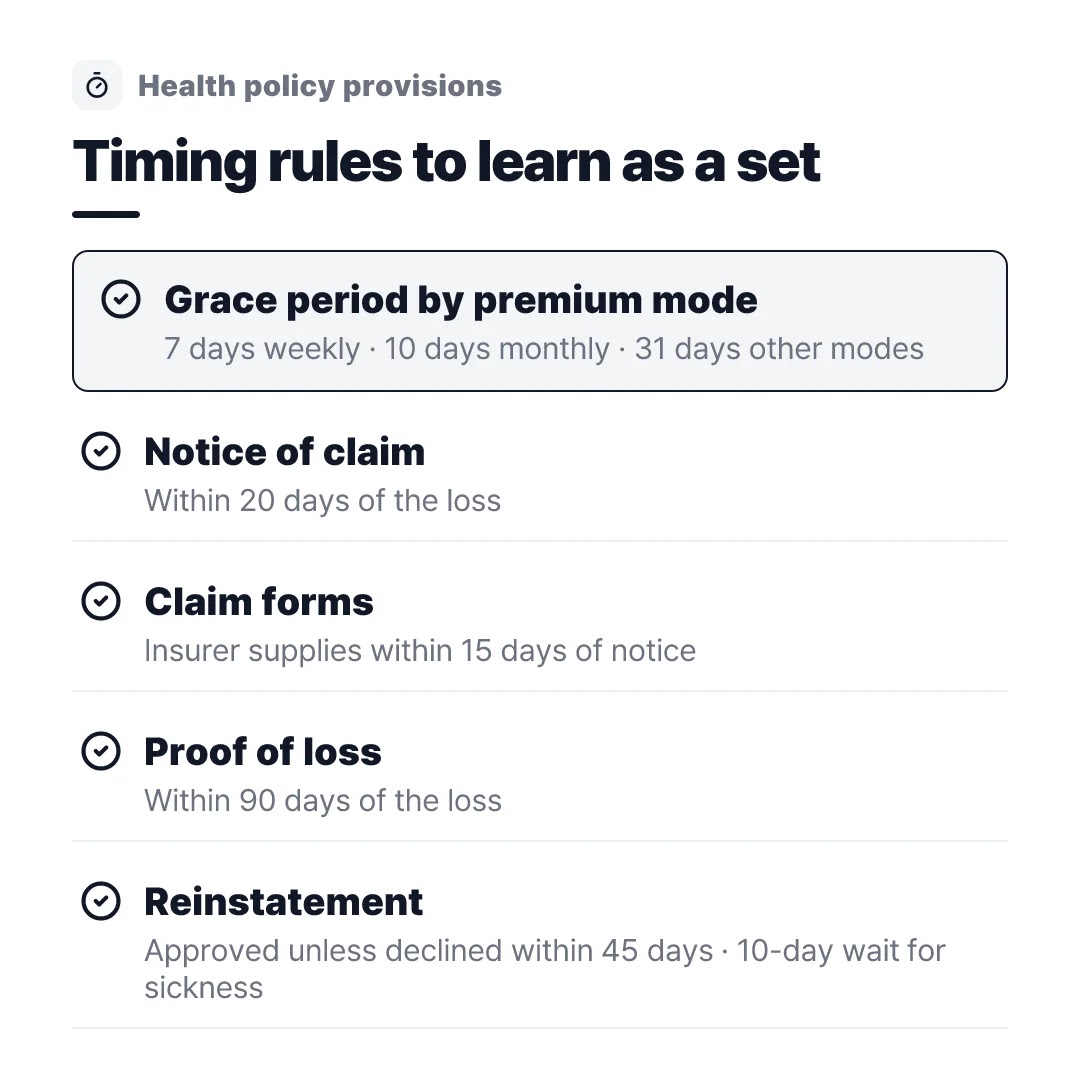
Start with policy provisions, because they show up on both the life and the health side and the two versions are easy to confuse. The health side follows the NAIC uniform provisions, which the notes list as 12 required and 11 optional. Grace periods there depend on premium mode (7 days weekly, 10 days monthly, 31 days for other modes), and the claim sequence runs on its own clock: notice of claim within 20 days, claim forms within 15 days of notice, proof of loss within 90 days. The numbers are close enough to blur together, so learn them as a set rather than one at a time.
Next, take health products as a comparison exercise rather than a list. Group versus individual disability income, business overhead expense versus disability buy-sell, and Medigap versus Medicaid-funded long-term care are all pairs where the exam asks which one does what. Prep providers flag Medicare supplement plans and disability elimination periods as the topics candidates find hardest, along with annuity taxation. Those are areas where memorizing a definition is not enough; you need to be able to place a client scenario in the right product.
Leave the state law portion for last, but do not skip it. In Texas the 30 state questions are scored together with the general portion, so a strong general score helps, but 30 of 130 scored items is too many to give away. In Florida, state law is a third of the exam. Study it from your own state's outline, using its code references, because no national guide can cover fifty insurance codes accurately.
Practice questions are worth doing once the concepts are in place, mainly to get used to scenario-style wording. Treat them as a check on understanding, not a substitute for it.
The Crammist Life and Health notes
The Crammist Life and Health notes are a 35-page review organized around the general knowledge topics that carry the most weight: policy provisions, riders, annuities, Medigap, and disability income. The notes are weighted toward tested topics rather than covering every line of the outline, and they are not built around any single state's insurance code, so plan to study your state law section from your own state's content outline.
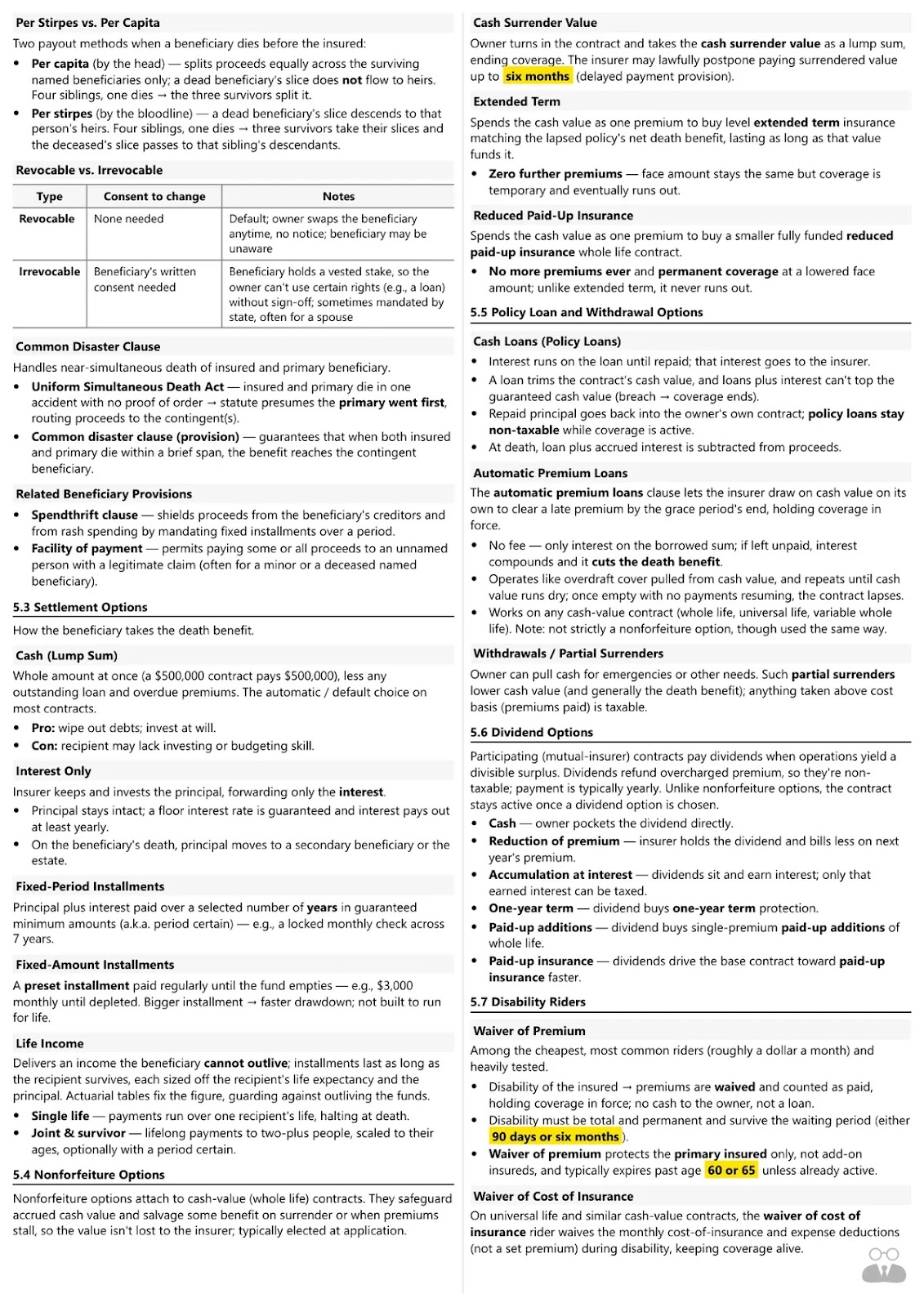
This page covers beneficiary designations (per capita versus per stirpes, revocable versus irrevocable, the common disaster clause), the five settlement options, the three nonforfeiture options, policy loans and automatic premium loans, the six dividend options, and the waiver of premium rider with its waiting period and age cutoff.

The Medicare supplement section lays out Plans A through N, the six-month open enrollment window, the core benefits every Medigap policy must carry, and the 2026 high-deductible amount for Plans F and G. It continues into Medicaid spend-down and long-term care insurance, including levels of care and the two-of-six ADL benefit trigger.
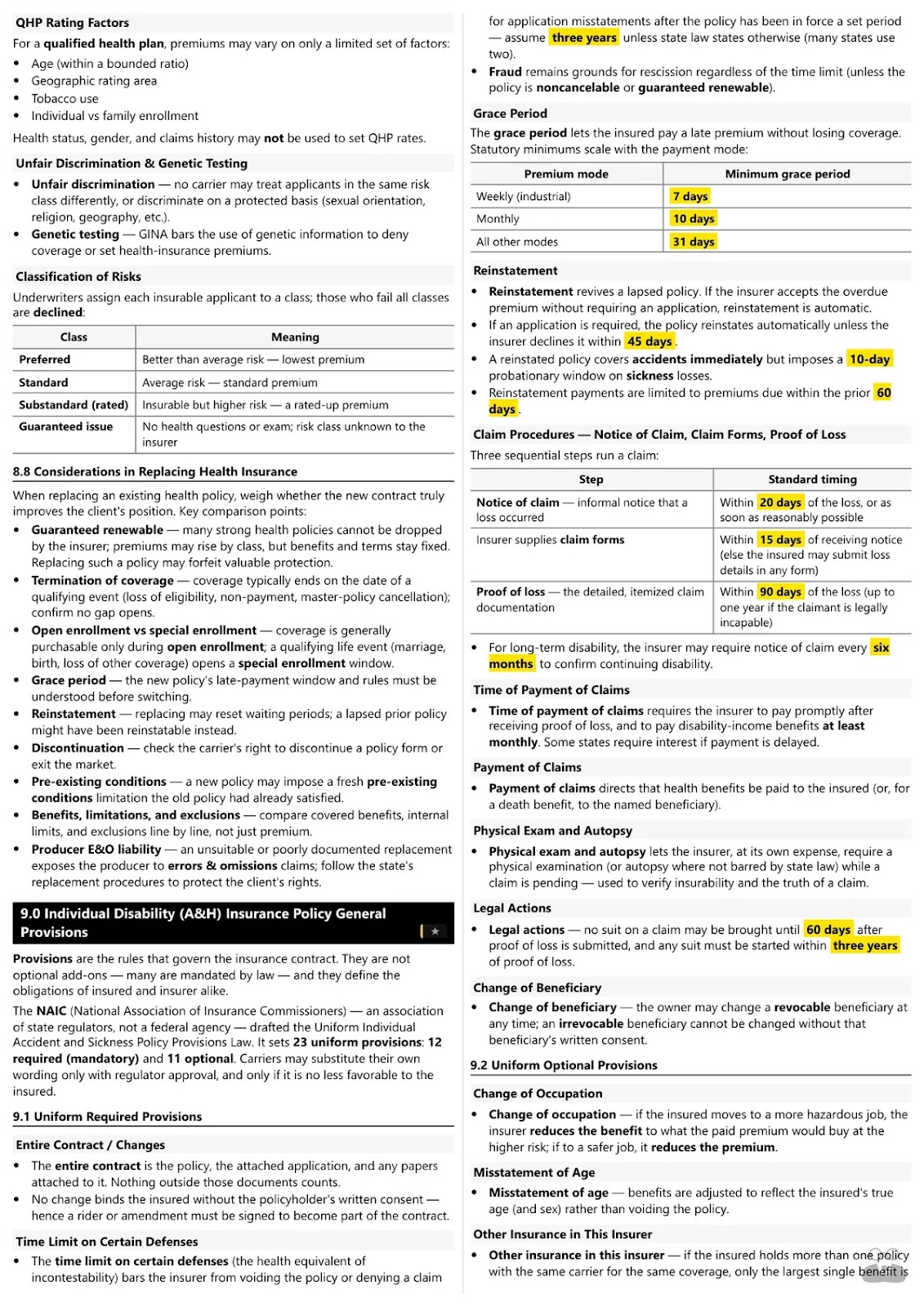
The provisions page puts the grace period table, the reinstatement rules, and the claim timeline side by side, next to the NAIC's split of 12 required and 11 optional uniform provisions and the rules for replacing health coverage.
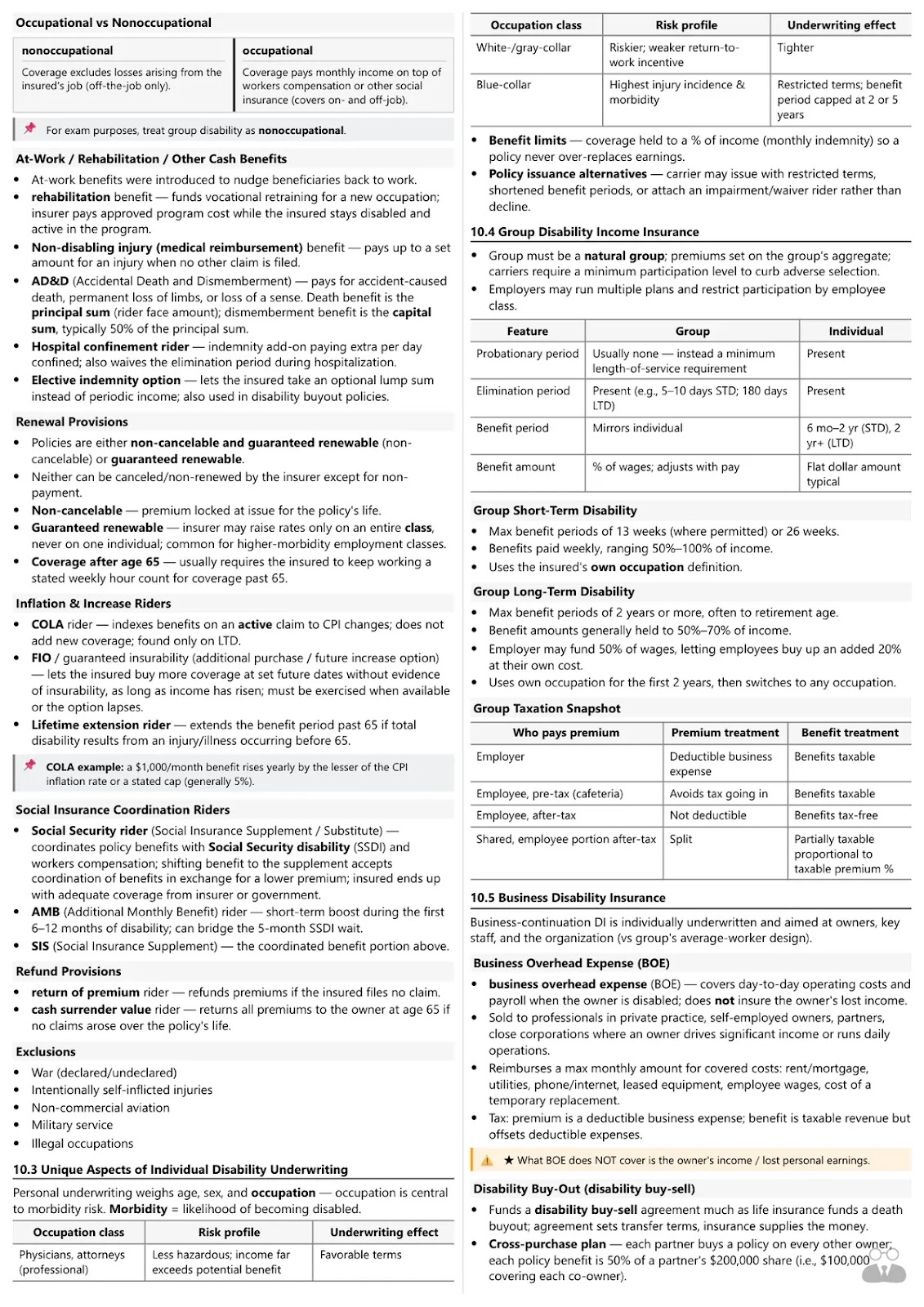
The disability income section compares group and individual coverage, short-term and long-term group plans, business overhead expense and buy-sell policies, and how benefits are taxed depending on who paid the premium.
👉 Life and Health Insurance exam study notes — PDF (35 pages)
https://www.crammist.com/library/life-health-insurance-exam-prep
FAQ
Can I use a life and health study guide written for another state?
For the general knowledge portion, largely yes, since the product concepts are the same everywhere. For the state law portion, no. Each state tests its own insurance code, and the share varies, from 30 of 130 scored items in Texas to a third of the exam in Florida.
How many questions are on the life and health insurance exam?
It depends on the state. Texas scores 130 questions in 150 minutes, Florida's 2-15 scores 150 in 2.75 hours, California gives 75 scored questions on each of its two separate exams, and New York's combined exam has 150. Pretest items are added on top in several states and do not count toward your score.
Is the passing score always 70%?
No. Texas, Florida, and New York require 70, but California passes candidates at 60%. Your state's handbook or bulletin states the current passing standard and whether it is applied to the whole exam or to each part.
Before you book
The life and health insurance license exam is a state exam, so the first step is your state department of insurance's licensing page, then the vendor's handbook and its effective date. Weight your study toward provisions and health products, which carry roughly half of the general knowledge items, and save a dedicated block for your state's law section. Once you know which outline applies to you, the notes cover the general knowledge side in 35 pages.
🎯 What actually gets tested on the Life and Health exam, condensed to 35 pages
https://www.crammist.com/library/life-health-insurance-exam-prep
Crammist is an independent study resource. It is not affiliated with or endorsed by any state department of insurance, the NAIC, Pearson VUE, or PSI.

